· Laying The Cards ·
The layout is the sentence.
The cards are the words.
Ten cards on a table are not necessarily a reading.
They are simply ten cards on a table.
What turns the cards into a reading is where each particular card sits.
Every position in a layout carries a meaning before anything is placed in it.
The card supplies one half and the position supplies the other.
This is why the same card, is never read the the same way twice.
The Tower behind you is something survived.
The Tower ahead of you is something coming.
Identical meaning, opposite reading, and the only thing that changed was the place it landed.
Learn three or four layouts properly, rather than collecting twenty.
A spread you know feel into well, will tell you more than an elaborate one.
Above all, trust your intuition for those intended for your practice.
- Before You Lay Them -
Ask a better question.
The question asked before you lay, shapes the answer more than the cards do.
Closed questions produce closed answers. Open questions open a doorway.
Ask whether he will call; and you will get yes or no, which gives you nothing further to act on.
Ask what is happening between you both, and the cards will have somewhere much more interesting to go.
Questions that work, usually begin with who, what, when, where or how.
What am I not seeing?
Why does this keep happening?
How do I approach this particular situation?
Avoid asking about other people's lives.
The cards will answer, and the answer will be your own hope or fear in disguise.
Ask about your life, actions and emotions instead.
Ask once, and let them lead.
Repeating a question until you receive the answer wanted, is not divination, nor is it helpful.
You will know if that's what you are doing - and a better question may be asking yourself why.
- Shuffling -
There is no correct method to shuffle.
Anyone who tells you otherwise is selling something specific.
Riffle, overhand, spread them across the table or push them about with both hands.
Stop when it feels like enough.
Cut the deck if you want to.
Draw from the top, the bottom or the middle.
Intuition matters more than technique.
Feel into your own way to do it, and listen to when it's your time to draw.
- Reading Reversals -
A reversed card is the same card.
It has not become its opposite and it has not turned against you.
It is the same energy arriving differently: blocked, excessive, turned inward, delayed, or refused.
Reversals will stop a reading from flattering you.
An upright-only deck tends to tell a nicer story than the one you are living.
They are not to be feared. They are a gift.
Shuffle so reversals can occur:
Turn half the deck, or spread the cards face down and move them about with both hands before gathering them.
Cards may also fall out while you shuffle.
That is not an accident. Ever.
A card or cards that leave the deck on their own have answered before you finished asking.
They belongs in the reading, exactly as they fall.
Set them aside and read them first.
The same is true of the reversal cards.
They are not the deck malfunctioning or the shuffle going wrong in any way.
They often carry more than the uprights do, because they tell you where the thing is stuck, rather than simply what it is.
Trust what arrives for you.
The deck is never careless or mistaken.
- The One Card Draw -
For daily practice and simple questions.
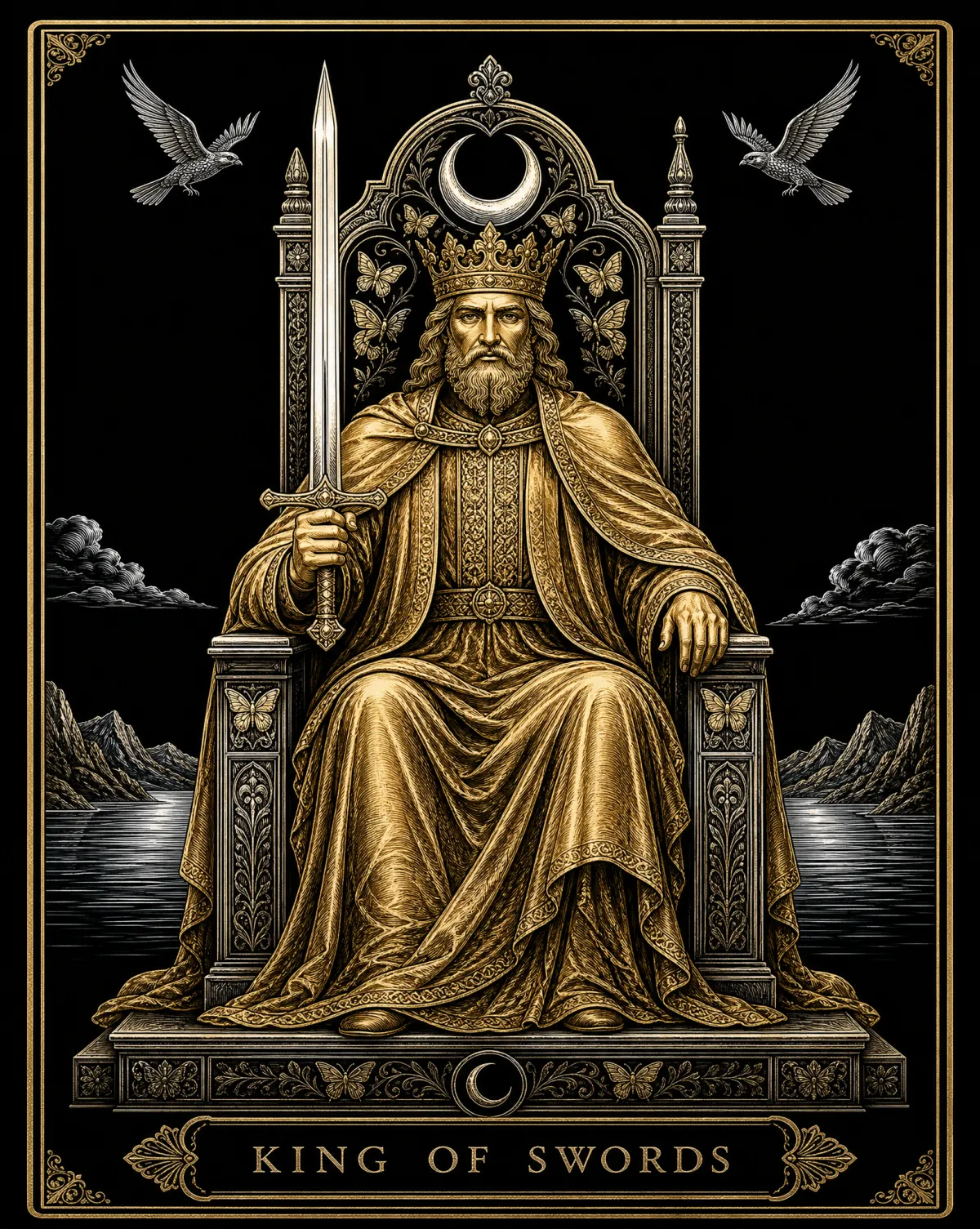
One card.
That is the entire layout.
Draw it in the morning and let it sit with you through the day, or draw it when a specific question needs a direct answer.
This is the layout most readers use most often, and the one that teaches the deck fastest.
The discipline is not to draw again.
One card, sat with properly, is worth more than five drawn in frustration.
- How to read it -
Look at the image before you look up the meaning.
What is the figure doing.
What are they holding.
Where are they looking.
Your first response to the picture is usually the reading. The written meaning is there to confirm or contain it.
- The Three Card Spread -
For situations with movement in them.
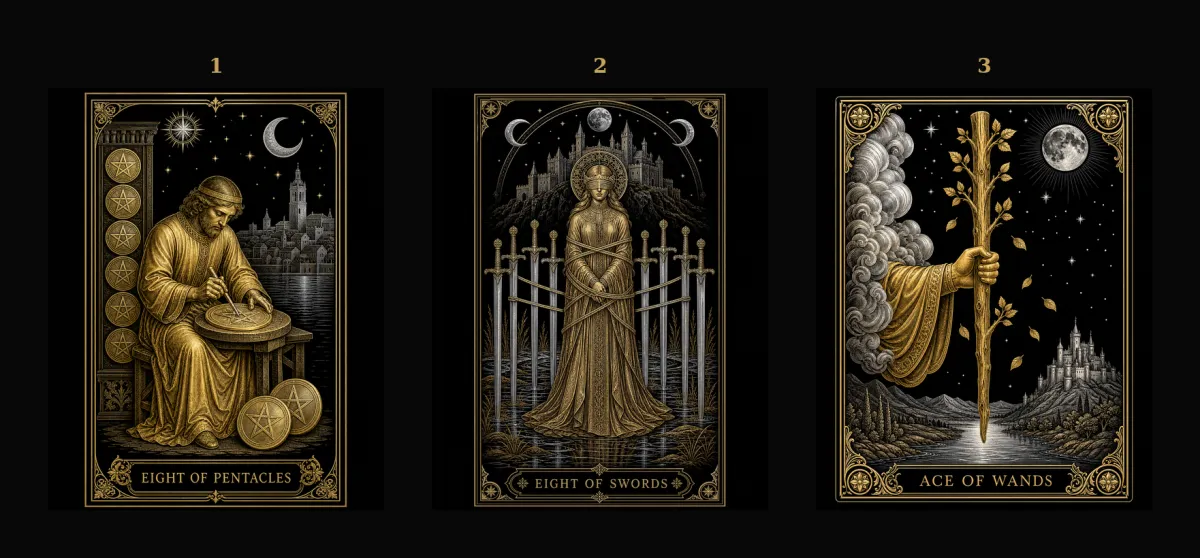
Three cards laid left to right.
The most useful layout in tarot and the one worth learning first.
Its power is that the positions can be anything, so long as you decide before you draw.
Past · Present · Future.
The standard. Where this came from, where it is now, where it is going.
Situation · Obstacle · Advice.
The most practical version. What is actually happening, what is in the way, what to do about it.
Mind · Body · Spirit.
For questions about yourself rather than circumstances.
What helps · What hinders · What you are not seeing.
For decisions.
Option one · Option two · What matters most.
For a choice between two paths, with the third card as the deciding value rather than the answer.
- How to read it -
Read the three as they sit together, before reading them each individually.
Notice whether the suits agree and whether the numbers rise or fall across the layout.
- The Cross -
For one question, examined in detail.
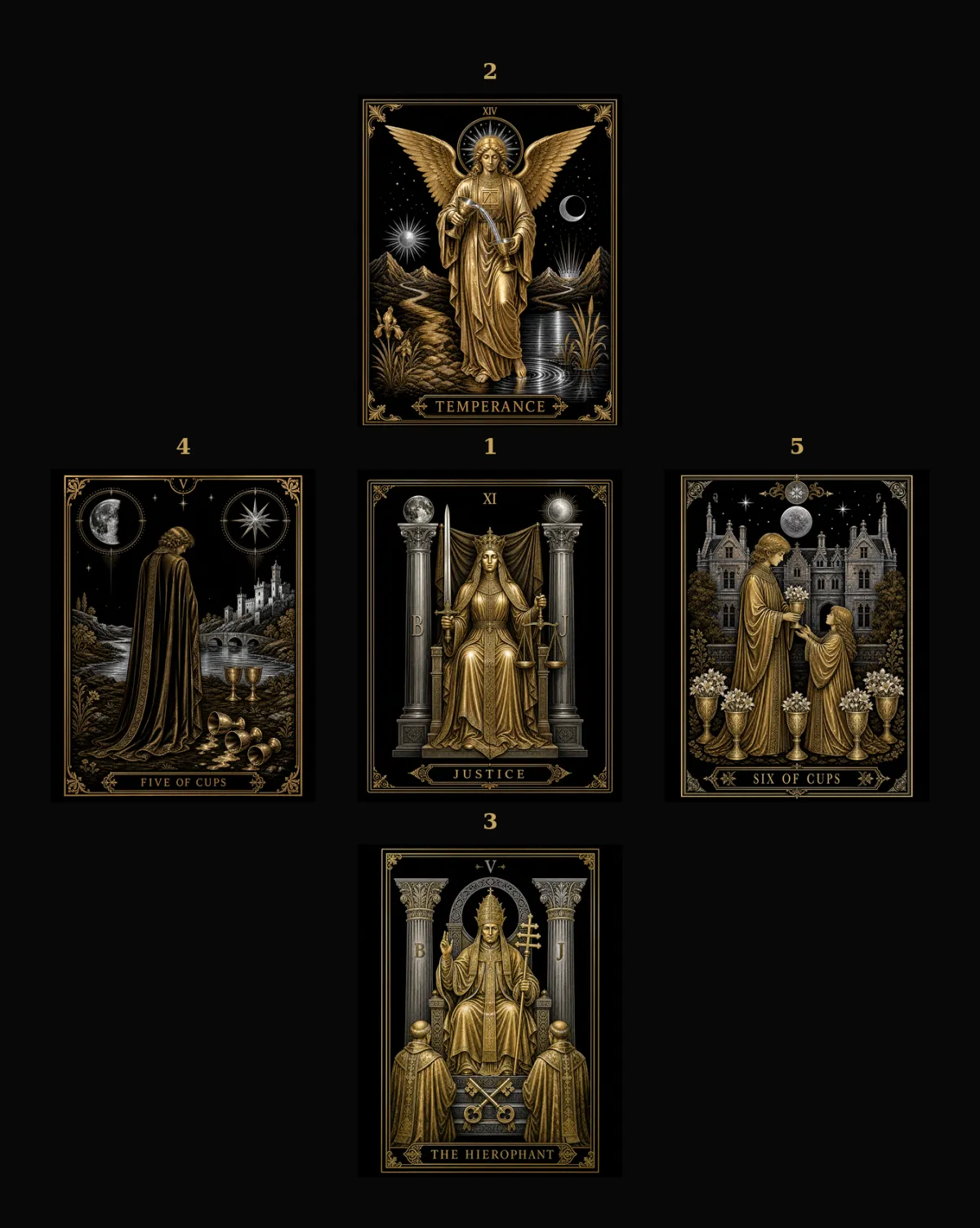
Five cards. A good middle layout when three is not enough and ten is too many.
Lay one card in the centre. One above, one below, one to the left, one to the right.
1. Centre.
The heart of the matter.
What this is actually about, which is not always what you asked.
2. Above.
What is conscious.
What you already know, or what is visible to everyone.
3. Below.
What is unconscious.
The part underneath, the real driver, the thing not being said.
4. Left.
What is passing.
What is behind this, or what is on its way out.
5. Right.
What is coming.
The direction of travel.
- How to read it -
Read the centre first and sit with it.
What a question is actually about, is often not what was consciously asked.
Then read the four around it as pairs.
Above and below are what you know against what is driving it.
Left and right are what is leaving against what is arriving.
Where a pair disagrees, that is where the work is.
Where they agree, that is what has been learned.
- The Celtic Cross -
For complicated situations with a lot underneath them.
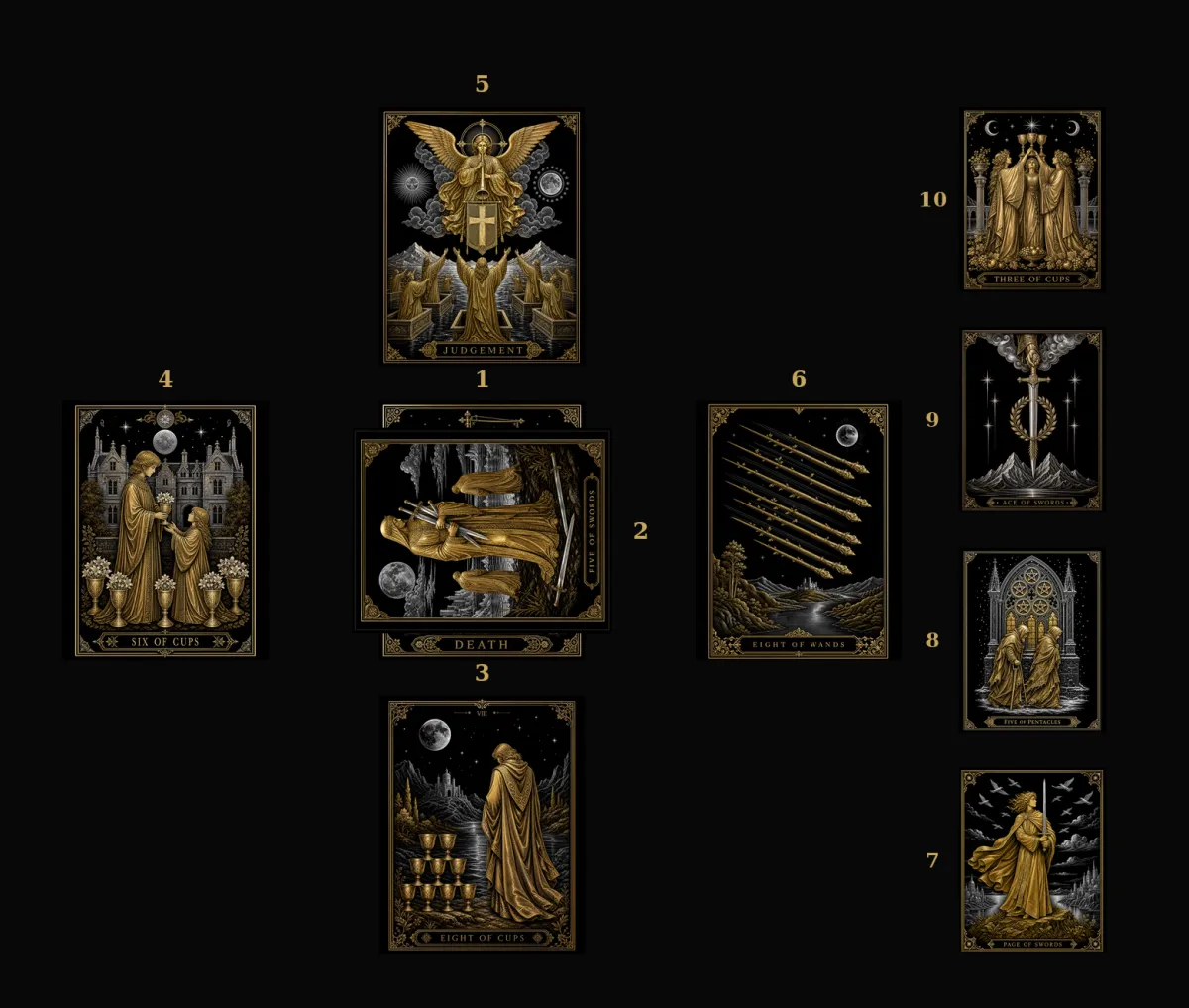
Ten cards, the oldest and best known layout in tarot.
It is genuinely complex and worth growing into rather than starting with.
One.
The present situation.
The heart of the question.
Two.
The challenge or crossing.
Laid sideways across the first. What opposes, complicates or challenges it.
This card can be helpful or obstructive, and it is always in tension with the first.
Three.
Below.
The foundation.
What this is built on, often unconscious.
Four.
Behind. The past.
What is moving out of the situation.
Five.
Above. The Crown.
The best possible outcome as things stand, or what is consciously hoped for.
Six.
Ahead. The near future.
What is arriving next, in the immediate term.
Seven.
Yourself. Your attittude. Your power.
How you are approaching this, and how you appear inside it.
Eight.
Around you. Environment.
Other people, environment, circumstances outside of your control.
Nine.
Hopes and fears.
These are the same card because they are usually the same thing.
Ten.
The final outcome.
Where this goes if nothing changes and current path holds.
- How to read it -
Read one and two together first, then three to six as the story, then seven to ten as the reading proper.
Do not read card ten as fate.
It is the direction of travel, and the whole point of a reading is that you can change it.
Position nine deserves attention.
The card there is often the one people argue with, and the argument is the information.
- The Art of Perception -
Sometimes the cards seem to conflict.
They may not make immediate sense, they may seem to contradict each other, or the cards may seem to repeat themselves.
The reading is there. But you may not be ready to see or hear it yet.
It is worth sitting with rather than shuffling past.
A reading that refuses to open immediately is usually one of the most powerful.
An answer is there, but it may not be the one you consciously came for.
The cards do not tell you what you want to hear.
They tell you what is true, and the gap between those two things is usually where your resistance lives.
Sit with what came.
Look at the card you least like or understand, and ask yourself simply, why.
Look at the one you keep explaining away.
Notice which one you wanted to draw instead.
That noticing is the subtext of your reading.
Never draw extra cards to soften what you have been given.
Every reading has divine intention in it.
Take it as it comes, even when it is not what you hoped for, especially then.
That is the learning.
That is the gift.
And it is always for you.
Everything offered here, including tarot card meanings, workings, correspondences, seasonal guidance and crystals, is for reflection and entertainment. It is not medical, legal, financial or psychological advice, and no outcome is promised. Crystals are sold as objects of beauty and ritual, not as remedies. Please consult a qualified professional for anything concerning your health, money or legal position. You are responsible for your own choices and for practising safely.
© 2026 Reyvene and duBois Consulting Pty Ltd. All rights reserved.